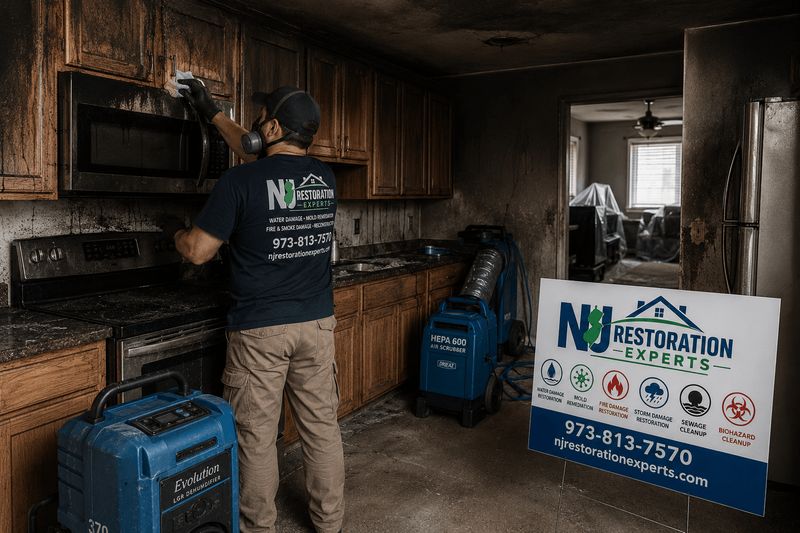
Smoke odor is the part of a fire that refuses to leave. Weeks after the flames are out — or years into owning a home a smoker lived in — the smell persists, spiking on humid days and every time the heat kicks on. That's because smoke odor isn't an odor floating in the air; it's microscopic residue bonded into drywall, wood, carpet, upholstery, insulation, and the inside of your HVAC system, re-releasing odor molecules continuously.
NJ Restoration Experts provides professional smoke odor elimination across Northern New Jersey — after house fires, kitchen fires, furnace puff backs, wildfire smoke events, and for homes with years of embedded cigarette or cigar smoke. Our process removes the residue that produces the odor, neutralizes what's absorbed into porous materials, and seals the surfaces where full removal isn't possible.
This is the job where over-the-counter approaches fail most reliably. Sprays, candles, and ozone rentals mask or partially treat the air while the source material keeps emitting. Real deodorization follows a sequence — remove the residue, clean the surfaces, treat the air and contents, address the ductwork, seal what remains — and skipping any step is why the smell 'comes back.' It never left.
What Our Smoke Odor Removal Service Includes
- Smoke Residue Source Removal
- HEPA Air Scrubbing & Filtration
- Hydroxyl & Ozone Treatment (Unoccupied)
- Thermal Fogging for Porous Materials
- HVAC Duct Cleaning Coordination
- Surface Cleaning & Degreasing
- Odor-Sealing Primers on Affected Surfaces
- Contents & Textile Deodorization
Why Smoke Odor Outlasts Everything Else
When materials burn, they release volatile compounds and microscopic particulate that ride the heat throughout the structure. Hot smoke is pressurized and mobile — it penetrates wall cavities through outlets and gaps, saturates attic insulation, coats the inside of duct runs, and drives residue deep into any porous surface it meets. As the structure cools, those particles bond. What you smell afterward is that embedded residue continuously off-gassing.
Different fires leave different odor problems. Protein fires — the burned dinner that 'wasn't that bad' — leave a nearly invisible film with a penetrating rancid odor that's notoriously persistent. Kitchen grease fires leave heavy residue in a concentrated area. Structure fires distribute residue everywhere the smoke traveled, which is usually the entire building. And long-term cigarette smoke creates a bonded nicotine film on every surface, layer over layer, for years.
Humidity and heat re-activate all of it — porous materials release more odor molecules as temperature and moisture rise, which is why the smell surges in summer and when the furnace runs. It's also why the HVAC system matters so much: residue-coated ducts redistribute odor through the whole house every cycle, undoing room-by-room cleaning efforts. Any serious deodorization plan includes the ductwork.
Dealing With Smoke Smell? Start Here
Whether it's post-fire or a smoker's house you just bought, a few steps help immediately — and a few common moves make it worse.
- Ventilate hard: open windows, run exhaust fans — dilution helps while the source remains
- Change HVAC filters now, and keep the system off if the odor clearly spikes when it runs
- Don't repaint yet — paint over unsealed smoke residue and the odor bleeds through within weeks
- Skip ozone rentals in occupied homes — effective ozone levels aren't safe to breathe
- Bag heavily affected soft goods (curtains, bedding) so they stop re-scenting cleaned rooms
- Call 973-813-7570 for an assessment — the treatment plan depends on the source and spread
If the odor follows a recent fire, don't wipe walls with ordinary cleaners — wet-cleaning certain soot types smears and sets the residue. Identifying the residue type comes before any cleaning.
Our Smoke Odor Removal Process
Source Assessment
We identify what burned (or was smoked), map where residue traveled — including cavities and ducts — and classify the residue type, which dictates the cleaning chemistry.
Residue Removal
Affected surfaces are cleaned with the correct method for the residue: dry sponging, degreasing, or specialized agents. Unsalvageable porous materials are removed.
Air Treatment
HEPA air scrubbers capture circulating particulate while hydroxyl generators — or ozone in unoccupied stages — break down odor molecules in the air and on surfaces.
Deep Deodorization
Thermal fogging drives neutralizing agents into porous materials along the same paths the smoke took — reaching what surface cleaning can't.
Ductwork & Systems
HVAC duct cleaning and system treatment stop the house from re-contaminating itself with every heating and cooling cycle.
Seal & Verify
Surfaces that can't be fully stripped of residue get odor-sealing primer before refinishing, and we verify the result room by room before we call it done.
Insurance Claims for Smoke Odor Damage
After a covered fire — including small kitchen fires and furnace puff backs — smoke and odor damage is part of the loss, and professional deodorization is a claimable cost. Carriers understand that smoke travels far beyond the burn area; the claim should reflect the real spread, which is exactly what our residue mapping documents room by room.
We photograph residue evidence throughout the structure, document affected contents and ductwork, and itemize the deodorization scope in adjuster-familiar terms. For odor without a fire event — a purchased smoker's home, for example — insurance doesn't apply, and we'll quote the work directly with the same transparency.
Why NJ Homeowners Call Us First
Source Removal, Not Masking
Fragrance and foggers alone wear off; we remove and neutralize the residue that generates the odor in the first place.
Residue-Correct Chemistry
Protein film, grease soot, and nicotine each demand different cleaning — using the wrong one sets the problem into the surface.
Cavities & Ducts Included
The odor you can't find is in wall cavities and ductwork; our plan treats the paths smoke actually traveled.
Occupied-Home Safe Methods
Hydroxyl treatment works while you live there; ozone is reserved for unoccupied stages with proper clearance.
Sealing Done Honestly
Where residue can't be fully removed — inside old plaster, charred framing — we say so and seal it properly instead of pretending.
Verified Before We Leave
The test is your nose in every room, and ours — plus the humid-day recheck we tell you to expect.
Helpful Resources
Curious how the pros actually do it? Our post on professional smoke odor removal goes method by method. If soot residue is visible, start with soot cleanup — and if a furnace blast caused it, see puff back cleanup. For the full post-fire picture, visit fire damage restoration and our guide to the fire restoration process.
Smoke Odor Removal — Frequently Asked Questions
Can smoke smell really be removed completely, or just reduced?
It can be eliminated when the full sequence is done: residue removal, correct surface cleaning, air treatment, duct cleaning, and sealing where needed. Partial approaches produce partial results — which is where the 'smoke smell never really goes away' belief comes from. Done completely, it goes away.
We had a small kitchen fire but the smell is everywhere. Why?
Smoke doesn't stay near the flame — it pressurizes and travels through the whole envelope, and kitchen protein-and-grease smoke is among the most penetrating and foul-smelling residue there is. The burn damage may be one cabinet; the odor job is usually the whole floor or house. Insurance claims for kitchen fires routinely include whole-home deodorization for exactly this reason.
Does ozone treatment work? Is it safe?
Ozone is effective at breaking down odor molecules, and at effective concentrations it is not safe for people, pets, or plants — which is why we use it only in unoccupied stages with airing-out before reoccupancy. For occupied homes, hydroxyl generators do similar work safely, just more gradually.
We bought a house from heavy smokers. What does removal involve?
Years of nicotine film means degreasing-level cleaning of every surface, duct cleaning, treatment or replacement of the most saturated porous materials, and stain-and-odor-blocking primer before repainting. It's very fixable — but paint alone is not the fix, and every buyer who tries it first learns why.
Will repainting cover the smoke smell?
Not over unsealed residue — the odor (and often yellow staining) bleeds through standard paint within weeks. The correct order is clean, neutralize, seal with a purpose-made blocking primer, then paint. Done in that order, paint is the finish; done alone, it's a delay.
How long does whole-home smoke deodorization take?
Typically several days to a week depending on severity: cleaning is the long stage, air treatment runs in parallel, and fogging and sealing come at the end. Post-fire jobs coordinate with the broader restoration timeline; smoker-home jobs usually run start to finish in under a week.