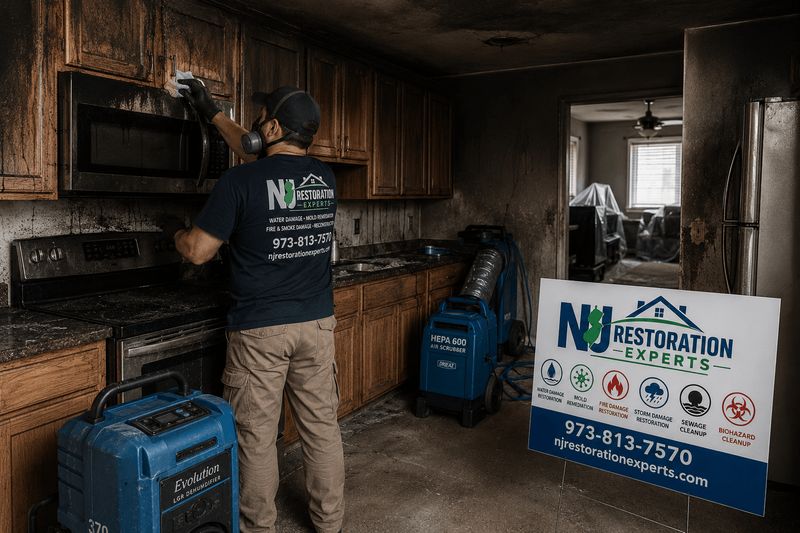
A puff back is what happens when an oil-fired furnace or boiler misfires: unburned fuel vapor accumulates in the combustion chamber, ignites all at once, and the small explosion blasts soot and partially burned oil back through the system — and, in forced-air homes, out of every supply register in the house simultaneously. Homeowners describe walking into a home where every room is coated in black, oily film, with soot 'webs' draped in corners like something out of a haunted house.
NJ Restoration Experts specializes in puff back cleanup across Northern New Jersey — a region where oil heat remains common in older housing stock, making this one of our signature winter losses. Puff back soot is petroleum-based: sticky, smeary, deeply staining, and bonded with fuel-oil odor. It cannot be cleaned like ordinary dust or even ordinary fire soot, and every wipe with the wrong product sets it deeper.
The good news inside the mess: puff backs are sudden, accidental mechanical events, which makes them one of the most consistently covered losses in homeowners insurance. The cleanup is extensive — every affected surface, contents, and the duct system itself — but it's a claimable, restorable event, and we document it accordingly from the first walkthrough.
What Our Puff Back Cleanup Service Includes
- Whole-Home Petroleum Soot Removal
- Degreasing-Grade Surface Cleaning
- Soot Web & Corner Deposit Removal
- HVAC Duct Cleaning Coordination
- Fuel-Oil Odor Neutralization
- Contents & Textile Cleaning
- Wall, Ceiling & Finish Restoration
- Full Insurance Claim Documentation
Why Puff Backs Happen — and Why They Hit the Whole House
The mechanics are simple and preventable: an oil burner that doesn't ignite properly lets unburned fuel vapor build in the chamber; the delayed ignition then combusts that accumulation with a bang — sometimes one dramatic blast, sometimes a series of smaller puffs that deposit soot gradually with each heating cycle. Causes include clogged nozzles, faulty ignition, shutdown-and-restart issues, and skipped annual service; most puff backs trace back to a burner that was due for maintenance.
Distribution depends on the heating system. Forced-air furnaces are the catastrophic version: the blast enters the supply plenum and the blower delivers soot to every register in the house within seconds — bedrooms, closets, everywhere, in one event. Steam and hot-water boilers concentrate the discharge near the unit, but soot still migrates through the house on air currents, and repeated small puffs coat basements and first floors over weeks.
What makes the residue special is the fuel. Petroleum soot is oily and electrostatically clingy — it forms the characteristic soot webs in cool corners, bonds to walls and ceilings, penetrates fabrics, and carries a persistent fuel-oil odor. Standard cleaners smear it; painting over it fails; and any cleanup that skips the ductwork gets undone the next time the blower runs. This is a specialty residue, and it gets a specialty process.
Just Had a Puff Back? Do This Now
The system caused it and the system can repeat it — so the first moves are about shutdown and containment.
- Shut the heating system off completely and leave it off until it's professionally serviced
- Call your oil service company for the burner repair — cleanup and repair run in parallel
- Don't wipe anything: petroleum soot smears into walls and fabrics with a single pass
- Keep traffic out of affected rooms; oily soot tracks and grinds into flooring
- Photograph every room, the registers, and the unit before anything is touched
- Call 973-813-7570 and notify your insurance carrier — this is a claimable event
If the home is without heat in winter, tell us and your carrier immediately — temporary heat is part of the emergency response, and frozen-pipe prevention becomes part of the plan while the system is down.
Our Puff Back Cleanup Process
Emergency Assessment
We walk every room documenting the soot distribution — puff back spread is deceptive, and closets, drawers, and upper shelves are checked, not assumed clean.
Stabilize the Scene
System confirmed off, traffic controlled, and the most vulnerable surfaces and contents protected from further contact damage.
Specialty Soot Removal
Petroleum residue is lifted with degreasing-grade agents and techniques matched to each surface — dry methods where they work, correct chemistry where they don't.
Duct System Cleanup
The ductwork that delivered the soot gets cleaned, or the next blower cycle re-contaminates the house; we coordinate this as a required step, not an option.
Deodorize
Fuel-oil odor is neutralized at the source and through air treatment — the smell is bonded to the residue, and it leaves when the residue and its traces do.
Restore & Document
Finishes restored, contents cleaned or inventoried for the claim, and the complete photo-and-scope package delivered for your adjuster.
Insurance Claims for Puff Backs
Puff backs sit squarely in covered-loss territory: a sudden, accidental mechanical discharge, with the resulting soot damage to the structure and contents claimable under standard homeowners policies. Carriers see these regularly in oil-heat regions like Northern New Jersey, and adjusters generally understand the whole-house scope that forced-air distribution creates — when it's documented properly.
That documentation is our first hour on site: room-by-room residue photos, register and duct contamination evidence, affected contents inventory, and the burner service records that establish the mechanical event. The furnace repair itself typically falls to your HVAC/oil service coverage or warranty rather than the homeowners claim, and we keep the two scopes cleanly separated so neither muddies the other.
Why NJ Homeowners Call Us First
Oil-Heat Country Experience
Northern NJ's housing stock keeps puff backs on our winter schedule — this is a residue and a claim type we know cold.
Petroleum-Soot Specialty
Sticky fuel soot has its own chemistry and technique; general cleaning approaches smear it, and we don't use them.
Ducts Treated as Step One
The delivery system gets cleaned or the loss repeats itself — we build the job around that reality.
Whole-House Thoroughness
Blast distribution reaches closets, drawers, and cabinets; our scope checks everywhere the blower pushed air.
Claim-Fluent Documentation
We hand your adjuster the loss in their own language: event evidence, spread mapping, contents inventory, scope.
Winter-Real Logistics
No-heat homes, frozen-pipe risk, temporary arrangements — we handle the season's complications, not just the soot.
Helpful Resources
Puff back soot behaves differently from other residues — our soot cleanup page explains the type-first approach, and smoke odor removal covers the fuel-oil smell that lingers after visible cleanup. Affected belongings go through contents cleaning & pack-out. For the broader recovery process, see fire damage restoration and our process guide. Also see our plain-English explainer on what a puff back is: read it here.
Puff Back Cleanup — Frequently Asked Questions
Every room in my house has black film after the furnace banged. Is that a puff back?
That's the textbook description — a delayed-ignition blast delivered through forced-air ductwork coats every room served by a register, and the bang you heard was the ignition event. Shut the system down, don't wipe anything, and start both calls: oil service for the burner, us for the cleanup.
Is puff back damage really covered by insurance?
Consistently, yes — it's a sudden and accidental mechanical event, which is the definition of covered territory. The soot damage to structure and contents is the claim; the burner repair itself is usually a service/warranty matter. We document both sides clearly so the claim moves without friction.
Can I clean puff back soot myself with degreaser?
We'd genuinely advise against it. Petroleum soot smears with the wrong dwell time, wrong agent, or wrong technique — and a smeared wall that would have wiped clean becomes a repaint. With a covered loss paying for professional cleanup, DIY risk buys you nothing.
Do the air ducts really need cleaning too?
Yes, and it's the least skippable step. The ducts are where the soot came from — they're coated inside, and every blower cycle redeposits residue into cleaned rooms. Duct cleaning after a forced-air puff back isn't an upsell; it's the difference between done and done twice.
How long does puff back cleanup take?
Most homes run several days to a week-plus depending on severity and size: surface cleaning is the long phase, ducts and deodorization follow, and contents cleaning runs in parallel. We'll give you a realistic room-by-room timeline after the first walkthrough.
How do I prevent another one?
Annual burner service, full stop. Nearly every puff back traces to a nozzle, ignition, or maintenance issue that a yearly tune-up catches. Once your oil company services the unit, keep that appointment every fall — it's the cheapest insurance in this whole story.