
Bathroom mold is where honest triage matters most, because the same black speckling can mean two completely different problems. Version one: surface growth on caulk, grout, and paint — the price of hot showers in a humid room, annoying, endlessly recurring, and genuinely a homeowner-level cleaning and ventilation issue. Version two: growth fed from behind — a shower valve seeping in the wall, a failed pan, a tile assembly letting water past — where the visible mold is the fruiting edge of a colony living in the wall cavity.
NJ Restoration Experts handles both versions across Northern New Jersey, and — more valuably — tells you which one you have. Our assessment uses moisture meters and pattern-reading to distinguish humidity mold from leak mold, because the treatments have nothing in common: one needs cleaning habits and a better exhaust fan; the other needs the wall opened, the leak fixed, the colonized materials removed, and the assembly rebuilt.
The tell most homeowners sense before they can prove it: recurrence and location. Surface mold spreads thin and wide where moisture films — ceiling paint, caulk lines, grout. Leak mold concentrates and returns aggressively in the same spot, stains from within, softens the wall, lifts tile, and often brings a persistent musty note that cleaning never touches. If you've cleaned the same patch four times this year, you already suspect the answer — and you're probably right.
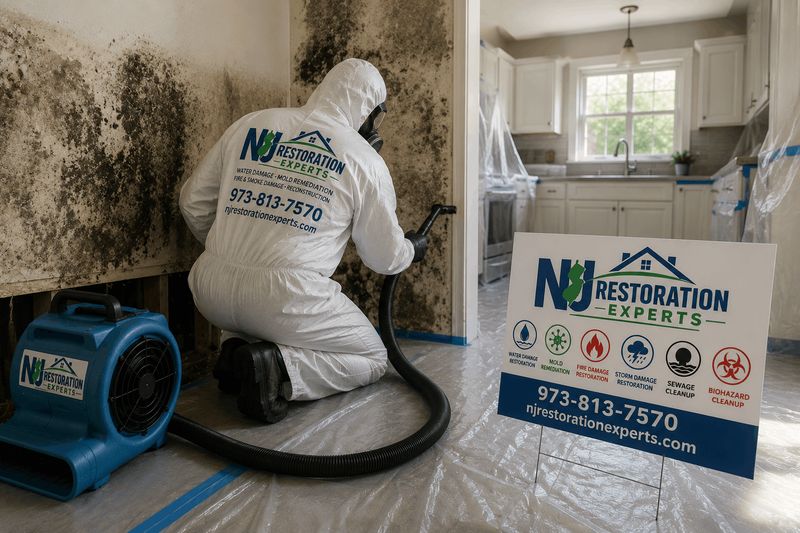
What Our Bathroom Mold Removal Service Includes
- Surface vs. Hidden-Source Diagnosis
- Moisture Metering of Walls & Floors
- Behind-Wall Mold Investigation
- Tile & Shower Assembly Assessment
- Contained Removal of Colonized Materials
- Leak Coordination & Rebuild
- Ceiling Mold Treatment
- Ventilation & Exhaust Fan Guidance
Humidity Mold vs. Leak Mold — the Two Bathrooms
The humidity version is universal physics. Every shower loads the room with saturated air; that moisture condenses on the coolest surfaces — ceiling paint, the window, the toilet tank — and films across caulk and grout. Where it lingers, common molds grow as surface speckling. The accelerants are familiar: an exhaust fan that's undersized, unused, or run for ninety seconds instead of twenty minutes; a windowless bath; paint that isn't moisture-rated; and caulk past its service life, whose porous surface holds the biofilm cleaning keeps almost removing.
The leak version is plumbing wearing a mold costume. Shower valves and drain connections seep inside walls; tile assemblies without intact waterproofing let shower water past the grout into the substrate; failed pans wick into subfloors; toilet rings weep at every flush. The water is small, continuous, and hidden — ideal mold conditions — and the growth it feeds lives in drywall backs, studs, and subfloor, showing at the surface only where it must. Meanwhile the assembly quietly rots: soft walls, hollow tiles, springy floor at the toilet.
Reading which bathroom you have is the diagnostic craft: growth pattern (thin and wide versus concentrated and returning), moisture readings through walls and floors (humidity mold meters dry between showers; leak mold doesn't), staining direction (surface film versus bleeding through from behind), and the assembly's own testimony — lifting tile, failing grout lines, that soft spot you've stopped pressing. Ten minutes with meters usually settles it, and everything that follows depends on the answer.
Recurring Bathroom Mold? Establish the Facts
A week of simple observation, or one metered assessment, tells you which problem you own. Meanwhile:
- Clean the visible growth once, properly, and note exactly where and how fast it returns
- Run the exhaust fan during and 20 minutes after every shower — door cracked, not sealed
- Press the suspicious wall gently: any softness or flex is a behind-wall answer, stop and call
- Check the floor at the toilet base and the ceiling below (if there's a room under the bath)
- Skip the bleach ritual on returning growth — recurrence despite cleaning is the diagnostic fact
- Call 973-813-7570 if it returns, concentrates, or anything feels soft — metering settles it fast
One more honest note: if your grout and caulk are visibly failing, water is getting behind the tile with every shower regardless of what the mold is doing today. Re-caulking and sealing is cheap prevention with or without a remediation.
Our Bathroom Mold Removal Process
Diagnose First
Meters, pattern-reading, and assembly checks determine surface versus hidden-source — the fork every other decision follows.
Honest Triage
Surface-level growth gets a cleaning-and-ventilation prescription, not a remediation invoice. Hidden-source findings get a scoped plan.
Contain & Open
For behind-wall work: containment protects the home, and the wall or floor opens where the moisture readings direct.
Fix the Water
The leaking valve, drain, pan, or assembly gets repaired — coordinated with your plumber or handled through our rebuild scope.
Remove & Treat
Colonized drywall, substrate, and framing surfaces are removed or treated under HEPA control until the cavity is clean.
Rebuild Right
Moisture-rated materials, proper waterproofing behind tile, and a finished bathroom built to stay dry — plus the fan-habit talk that keeps the surface version away too.
Insurance Claims for Bathroom Mold & Hidden Leaks
Bathroom mold coverage follows the source, and the hidden-leak version has a real path: mold resulting from a sudden plumbing failure is typically covered within policy mold limits, and many carriers also cover damage from leaks that were genuinely concealed within walls — the homeowner couldn't reasonably have known. Long-term visible seepage and humidity mold, by contrast, read as maintenance and are generally excluded.
Concealed-leak claims live or die on documentation, which is where our process earns its keep: moisture mapping that shows the hidden path, photos of the colonized cavity at opening, and the plumbing failure recorded before repair. We build that file as the work proceeds — and when the answer is the humidity version, we tell you plainly that this one's a cleaning-and-ventilation fix, not a claim.
Why NJ Homeowners Call Us First
Triage You Can Trust
We tell homeowners 'this is a cleaning task' when it is — the credibility behind our word when it isn't.
Meter-Settled Answers
The surface-versus-leak question gets resolved with readings, not guesses or worst-case pricing.
Assembly Literacy
Shower pans, valve walls, tile substrates — we know where bathrooms leak and what the failures look like from both sides.
Contained, Clean Work
Bathroom remediations run with containment and HEPA control; the rest of your home stays out of it.
Leak-to-Finish Scope
Water fixed, mold removed, bathroom rebuilt with waterproofing done right — one accountable sequence.
Recurrence Actually Ends
Whichever version you had, it ends: the leak version by repair, the surface version by the ventilation fix we spec.
Helpful Resources
For the health-and-humidity background, see mold and indoor air quality and how fast mold grows. If the ceiling below the bathroom shows staining, that's ceiling water damage territory; a toilet event is toilet overflow cleanup. Species worries? Read the honest take at black mold removal. Verification lives at mold inspection & testing.
Bathroom Mold Removal — Frequently Asked Questions
The mold on my shower caulk keeps coming back no matter how much I clean. Leak?
Caulk-line recurrence alone is usually the humidity version — caulk's surface holds biofilm that regrows from traces, and aging caulk gets worse at it every year. The fix is replacement caulk (mold-resistant), sealed grout, and real exhaust-fan habits. It becomes a leak question when recurrence concentrates in one wall area, the wall softens, or growth returns within days — then we meter.
There's a black patch on the bathroom ceiling. What is it?
Over the shower, it's most often condensation mold on ceiling paint — the warm-moist-air-meets-cool-ceiling story, treated with cleaning, moisture-rated paint, and ventilation. If it's positioned below an upstairs bathroom or under the roof, it earns a moisture check before cosmetic treatment: position is the clue, and a meter reading settles it.
My tiles sound hollow and the grout keeps cracking. Is water behind them?
Those are the classic signs — hollow-sounding tile and recurring grout failure suggest the substrate behind is compromised, usually from water getting past the surface over time. Add returning mold and the picture firms up. An assessment tells you whether you're re-grouting a sound wall or opening a failed assembly, and honestly, you want to know which before it chooses for you.
Can I remediate bathroom mold myself?
Surface growth on non-porous surfaces — yes, genuinely: proper cleaner, replaced caulk, better ventilation, done. Established growth in drywall, behind tile, or under flooring — no: disturbance without containment spreads spores, and removal without fixing the water guarantees an encore. Our assessment tells you which side you're on, and we're comfortable saying 'you can handle this one.'
Does the exhaust fan really matter that much?
It's the single highest-leverage factor in the humidity version. A properly sized fan, run through the shower and 20 minutes after, removes the moisture load before it condenses and feeds growth. Most recurring surface mold traces to a fan that's too small, too clogged, or turned off with the light. It's the cheapest fix in this entire category.
The wall behind our shower valve is soft. How bad is this going to be?
Soft means the substrate has been wet long enough to degrade — plan on opening that wall, fixing the valve leak, removing colonized material, and rebuilding with proper waterproofing. It's a real project but a contained one, and it may have claim potential as a concealed leak. What it isn't is optional: soft walls only travel one direction.