A ceiling stain is never just a ceiling stain. It's the visible edge of water collecting in the cavity above — from a bathroom leak, a burst pipe, a roof problem, or an overflowed appliance on the floor upstairs. Drywall holds a surprising amount of water before it lets go; a sagging, bulging ceiling is one that's close to failing.
NJ Restoration Experts handles ceiling water damage across Northern New Jersey from diagnosis through restoration. We use thermal imaging and moisture meters to find where the water is actually coming from and how far it has spread — which is frequently well beyond the visible stain — then dry the cavity, remove what can't be saved, and restore the finish.
The order of operations matters. Patching and painting over a stain without drying the cavity and stopping the source guarantees the stain returns — usually with mold behind it. We fix the problem in the right sequence so it's fixed once.
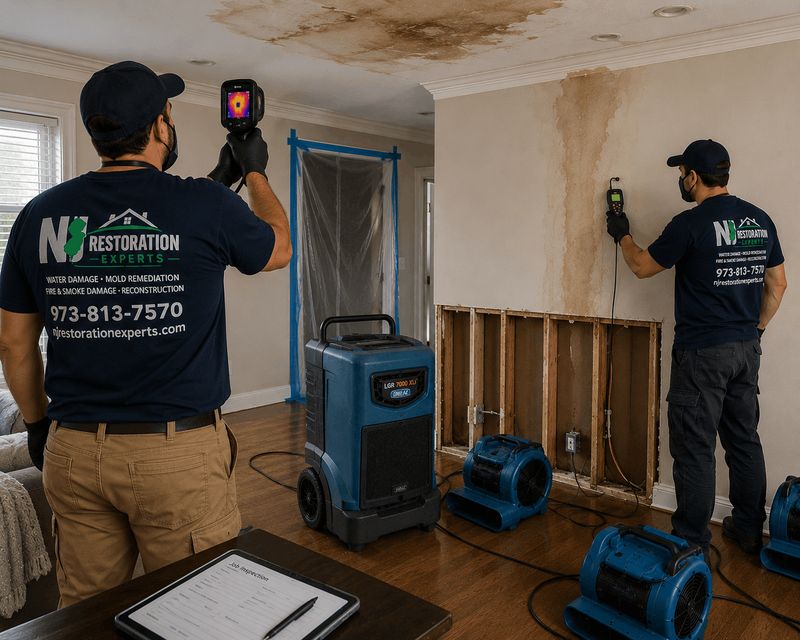
What Our Ceiling Water Damage Repair Service Includes
- Leak Source Tracing with Thermal Imaging
- Emergency Water Release & Containment
- Ceiling Cavity & Insulation Drying
- Wet Insulation Removal & Replacement
- Drywall & Plaster Ceiling Repair
- Stain-Blocking, Texture & Paint Matching
- Mold Prevention Treatment
- Full Photo & Moisture Documentation
What's Actually Leaking Above Your Ceiling
Upstairs plumbing leads the list in multi-story New Jersey homes: tub and shower drain connections that seep with every use, worn toilet wax rings, corroded supply lines, and radiator or baseboard heating connections. These produce the classic slowly-growing brown ring — a little water with every use, accumulating in the cavity for weeks before the stain appears.
Roof-related water is the other major source, and it behaves differently. Storm-driven leaks, failed flashing around chimneys and vents, clogged gutters pushing water under shingles, and winter ice dams all send water into the attic, where it travels along rafters and framing before dropping onto the ceiling below — often several feet from the actual entry point. That travel is why the stain location rarely marks the leak location.
Then there are the sudden events: a burst pipe in the ceiling cavity, an overflowing tub or toilet upstairs, a failed washing machine hose on the second floor. These dump water fast, and a bulging ceiling can follow within hours. If your ceiling is visibly sagging or dripping, treat it as urgent — a saturated drywall ceiling can collapse without much warning.
Sagging or Dripping Ceiling? Act Now
A bulging ceiling is holding water and getting heavier. A few careful steps protect your home — and keep you out from under it.
- Keep people and pets out of the room, especially from directly under any bulge
- Shut the water main if the source could be plumbing; stop using upstairs fixtures either way
- Kill power to the room if water is near light fixtures — light cans are a common drip path
- Put down buckets and plastic sheeting to catch water and protect flooring
- If a bulge is holding water, a small controlled hole at its center into a bucket can prevent a larger collapse — only if you can do it safely from the side
- Photograph everything, then call 973-813-7570 for emergency response
Don't cut into or press on a heavily sagging area from directly beneath it. If in doubt, close the door and leave it for our crew — a controlled release with the right equipment is far better than a collapse.
Our Ceiling Water Damage Repair Process
Rapid Response
We treat active ceiling leaks as emergencies — a crew is dispatched with imaging equipment, containment, and drying gear.
Find the Real Source
Thermal imaging and meter mapping trace the water to its origin — plumbing, roof, or overflow — not just to where it shows.
Controlled Release & Containment
Trapped water is released safely, floors and contents below are protected, and the affected area is contained.
Open & Dry the Cavity
Saturated sections and wet insulation are removed; air movers and dehumidifiers dry framing and remaining materials to verified targets.
Treat & Prevent
The cavity gets antimicrobial treatment so the dark, enclosed space above your ceiling doesn't become a mold farm.
Restore the Finish
New drywall or plaster repair, stain-blocking primer, texture matching, and paint — a ceiling that looks like nothing ever happened.
Insurance Claims for Ceiling Water Damage
Coverage for ceiling damage almost always turns on the source. Sudden events — a burst pipe, an appliance failure, storm damage to the roof — are typically covered, including the resulting ceiling repairs. Long-term seepage that a carrier deems neglected maintenance often isn't. That distinction makes accurate source identification the most valuable part of the claim.
Because we trace the leak with imaging and document the water path from origin to stain, your claim is built on evidence rather than assumption. We photograph the source, the cavity, and the drying process, log every moisture reading, and provide a clear repair scope your adjuster can approve without back-and-forth.
Why NJ Homeowners Call Us First
We Find the Source, Not Just the Stain
Imaging-led diagnosis means the actual leak gets fixed — so the repair you pay for doesn't repeat.
Collapse Prevention
Controlled water release and fast cavity drying keep a heavy, saturated ceiling from coming down on your room.
Cavity-Deep Drying
We dry the space above the ceiling — framing and insulation included — not just the visible surface.
Invisible Repairs
Texture and paint matching that makes the patch disappear, on drywall and older plaster alike.
Mold Stopped Before It Starts
Enclosed ceiling cavities are prime mold territory; antimicrobial treatment and verified drying close that door.
Source-to-Finish Accountability
Diagnosis, drying, and finish restoration by one crew — no gaps between trades.
Helpful Resources
Not sure what's causing the stain? Our post on ceiling water damage causes walks through the patterns. If the source is above the roofline, see our roof leak water damage and ice dam water damage services. For repair details, read our drywall repair guide, and if a pipe caused it, start at burst pipe cleanup.
Ceiling Water Damage Repair — Frequently Asked Questions
Is a water-stained ceiling an emergency?
A dry, old stain is a diagnosis job — schedule it soon. A growing stain, active dripping, or any sagging is urgent: water is accumulating, drywall is weakening, and mold conditions are developing in the cavity. When in doubt, call and describe it; we'll tell you honestly which one you have.
Will my ceiling collapse?
Saturated drywall can fail, especially where a visible bulge is holding water. Keep everyone out from under it and call us — a controlled release takes minutes and removes the danger. Plaster ceilings hold longer but fail more heavily, so treat sagging plaster with extra caution.
Can you fix the ceiling or just dry it?
Both. We dry the cavity, replace what was removed, and restore the finish — drywall or plaster repair, stain-blocking primer, texture and color matching. Most repaired ceilings are indistinguishable from the original when we're done.
Why is the stain nowhere near the leak?
Water travels. It follows pipes, rafters, and framing until it finds a low point to collect, then shows up there — sometimes rooms away from the entry. That's exactly why we trace with thermal imaging instead of opening the ceiling at the stain and hoping.
Do you handle plaster ceilings in older NJ homes?
Yes. Much of Northern New Jersey's housing stock has original plaster, which absorbs and holds water differently than drywall. We assess whether it can be dried and consolidated or needs sectional replacement, and we match the existing finish either way.
Should I just paint over an old water stain?
Only after two things are true: the source is verifiably fixed and the cavity is verifiably dry. Then a stain-blocking primer plus paint finishes it properly. Painting over an active or damp stain buys a few weeks of appearance and lets the real problem grow.