Every New Jersey homeowner knows the smell — that musty, earthy basement odor that intensifies in summer and gets politely called 'basement smell,' as if it were a feature of the architecture. It isn't. It's microbial: active mold and bacteria metabolizing in damp corners, on foundation walls, along joist bays, behind stored boxes, and inside finished walls, announcing themselves through the one sense that finds them before the flashlight does.
NJ Restoration Experts remediates basement mold throughout Northern New Jersey — from surface growth on block walls to colonized joists and sill plates, from the storage-area corner to fully finished basements where the growth lives behind drywall. Containment, HEPA filtration, removal and treatment, and then the part that makes it permanent: getting the basement's chronic moisture under control.
Because basements are mold's favorite room for structural reasons: below grade, surrounded by damp soil, naturally cool (which means naturally humid in summer, when warm air hits cool surfaces and condenses), and finished with materials that feed growth the moment they stay damp. A basement mold job that doesn't address humidity and water entry is scheduled to repeat itself — ours are built not to.
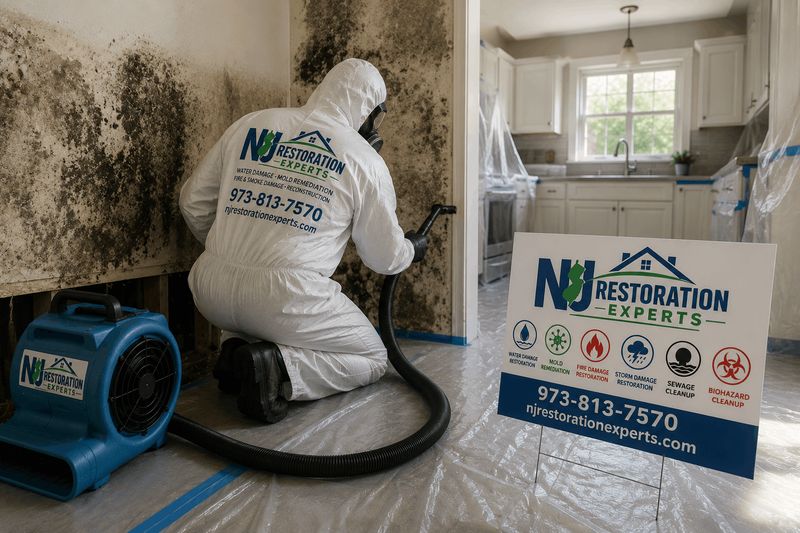
What Our Basement Mold Removal Service Includes
- Foundation Wall Mold Remediation
- Joist, Sill & Framing Treatment
- Finished Basement Investigation & Removal
- Containment & HEPA Air Control
- Musty Odor Source Elimination
- Humidity & Condensation Assessment
- Water Entry Point Identification
- Dehumidification Strategy & Setup
Why New Jersey Basements Grow Mold
Start with summer humidity — the quiet cause behind most NJ basement mold. Warm, moist June-through-September air infiltrates the basement and meets surfaces that sit at ground temperature year-round; relative humidity at those cool walls and slabs climbs past the growth threshold and stays there for months. No leak, no flood, no event — just physics, running every summer, feeding growth on walls, stored belongings, and joist bays. It's why the musty smell peaks in August and why a properly sized dehumidifier is basement equipment, not a luxury.
Then the water entries: hydrostatic seepage through block walls and cove joints after rain, grading and gutter problems delivering roof water to the foundation, sump systems that lag the water table, and the one-time flood that was cleaned up but never professionally dried. Each keeps materials damp on its own schedule, and each leaves a signature — efflorescence and shadow staining on walls, a tide line, growth concentrated where the water history is.
Finished basements add the concealment layer. Drywall against foundation walls, carpet on slab, and framed-out rim joists create cavities where moisture condenses and growth proceeds invisibly for years — discovered when a renovation opens a wall or the odor finally forces the question. Investigating finished spaces without wholesale demolition is a judgment skill: moisture meters, borescope checks, and targeted openings where the readings point.
Musty Basement or Visible Growth? Start Here
Before remediation, a few moves help — and a few common ones feed the problem.
- Trust the smell: persistent mustiness means active microbial growth somewhere, found or not
- Pull stored items away from foundation walls — cardboard against block is a mold sandwich
- Run a dehumidifier now if you have one; below 50% humidity slows everything down
- Don't paint over wall growth with waterproofing paint — it traps moisture and hides the evidence
- Note where and when: after rain? all summer? one corner? The pattern is diagnostic
- Call 973-813-7570 for an assessment that includes the moisture story, not just the visible mold
If your basement flooded in the past and was 'dried with fans over a weekend,' mention it — incompletely dried floods are the origin story of a large share of the finished-basement mold we find.
Our Basement Mold Removal Process
Moisture-First Assessment
Humidity levels, wall and slab readings, water entry evidence, and the growth pattern together tell us what this basement's problem actually is.
Contain & Control Air
Containment and negative air with HEPA filtration keep spores out of the upstairs living space throughout the work.
Remove & Treat
Colonized porous materials come out; block walls, joists, sills, and framing are cleaned and treated — growth removed from the structure, not sealed into it.
Open Where the Meters Point
In finished basements, targeted investigation finds concealed growth with minimal demolition — and full removal where it's established.
Control the Moisture
Dehumidification sized and set up, condensation addressed, water entries identified — with referral coordination where drainage or waterproofing work is needed.
Verify & Advise
Clearance confirmed, and you get the honest maintenance picture: what to run, what to watch, and what storage habits keep it gone.
Insurance Claims for Basement Mold
Basement mold follows the standard coverage logic, with a basement-specific twist. Mold resulting from a covered sudden loss — the burst pipe, the water heater failure — is typically covered within your policy's mold limit. Mold from chronic humidity, seepage, or gradual water entry is generally excluded as maintenance. The twist: many basement colonies trace to an old flood event, and whether that event was covered (and claimed) shapes what's possible now.
We reconstruct the moisture history honestly — meters, staining patterns, and your account — and document accordingly. When a covered origin exists, the documentation supports the claim; when it's the chronic-humidity story, you get transparent direct pricing and, more importantly, a moisture-control plan that ends the cycle regardless of who pays for this round.
Why NJ Homeowners Call Us First
Humidity Treated as the Headline
Summer condensation drives most NJ basement mold — our fix leads with moisture control, not just surface treatment.
Finished Basements, Minimal Demo
Meters and targeted openings find concealed growth without gutting rooms on suspicion.
Structure-Deep Treatment
Joists, sills, and block get genuinely cleaned and treated — the framing your house stands on, handled like it matters.
The Smell Actually Ends
Musty odor is microbial; when the sources are removed and the humidity is controlled, the basement smells like nothing.
Storage-Reality Guidance
We'll show you what to store how — the cardboard-on-concrete habits that regrow colonies get named specifically.
Flood-History Literacy
Old water events leave signatures we know how to read — and their leftover dampness gets finished properly this time.
Helpful Resources
The musty-smell question has its own post: what causes musty smells in a house. If your basement floods, start at basement flood cleanup and read mold after flooding and dehumidifiers vs. professional drying. Related spaces: crawl space mold, black mold removal. Waterproofing questions? See waterproofing vs. restoration.
Basement Mold Removal — Frequently Asked Questions
My basement smells musty but I can't see any mold. Is it really there?
Persistent musty odor is microbial activity with high reliability — the growth is behind stored items, inside finished walls, in joist bays, or distributed as surface film you haven't caught in the right light. An assessment with moisture meters finds what the nose already reported. The smell is evidence; take it seriously and skip the air fresheners.
Is the white fuzzy stuff on my block walls mold?
Sometimes — and sometimes it's efflorescence, mineral salt deposits left by moisture migrating through the masonry. Quick tell: efflorescence is crystalline and dissolves in water; mold is soft and smears. Either way the message is the same — moisture is moving through that wall — but the response differs, and we identify which you have on sight.
Can I just run a dehumidifier and call it handled?
A dehumidifier is essential basement equipment and genuinely prevents humidity-driven growth — but it doesn't remove established colonies, and it can't outrun active water entry. The sequence that works: remediate the existing growth, address water entries, then dehumidification keeps the dry basement dry. Right tool, right slot in the order.
We're finishing our basement. Should we deal with mold first?
Emphatically yes — finishing over existing growth or unresolved moisture builds the problem into the walls, where it grows concealed and emerges as a much larger project later. Remediate, control the moisture, confirm dry conditions, then finish with basement-appropriate materials. It's the difference between a basement you enjoy and one you re-open in five years.
Is basement mold making my whole house smell?
It can — the stack effect draws basement air upward through the house, carrying the mustiness with it. If guests smell 'old house' on the first floor, the basement is the usual origin. It also means basement air quality isn't sealed away from living space, which is a fair reason to prioritize the remediation.
Does homeowners insurance cover basement mold?
If it grew from a covered sudden water loss, typically yes within your mold limit. If it's the chronic humidity and seepage story — the most common basement scenario — typically no. We give you the honest read after seeing the moisture evidence, and transparent pricing either way.