
When a water heater lets go, the damage math is worse than most homeowners expect. The tank itself holds 40 to 80 gallons — but a ruptured tank keeps refilling from the supply line, releasing water continuously until someone closes the valve. A failure that starts overnight can put hundreds of gallons across a basement or utility closet floor by morning.
NJ Restoration Experts provides 24/7 water heater leak and failure cleanup throughout Northern New Jersey. We shut down the loss, extract the water, dry the surrounding structure — including the walls and flooring that wicked water while it spread — and document everything for what is usually a very claimable insurance loss.
Location makes these losses sneaky. Water heaters live in basements, garages, closets, and utility rooms — low-traffic spots where a slow leak can run for days before anyone notices. By then, water has crept under adjacent flooring and into wall bases well beyond the puddle you can see. Our meters find the full footprint so all of it gets dried.
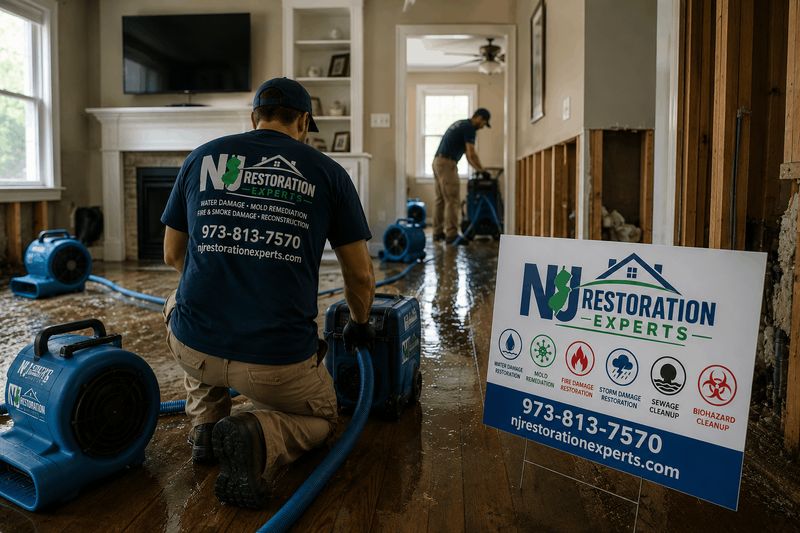
What Our Water Heater Leak Cleanup Service Includes
- Emergency Shutoff & Loss Control
- Standing Water Extraction
- Utility Room, Closet & Basement Drying
- Adjacent Flooring & Wall Base Drying
- Sanitizing & Odor Treatment
- Tank Failure Documentation for Insurance
- Moisture Mapping of the Full Spread
- Structural Drying Verification
How Water Heaters Fail — and Why It's Usually Sudden
Tank corrosion is the slow killer. Over 8–12 years, sediment builds at the tank bottom, the sacrificial anode rod is consumed, and rust goes to work on the steel from the inside. The first visible symptom is often the last: a rusty weep at the bottom seam that becomes a rupture. If your unit is past ten years old, it's living on borrowed time, and its floor placement decides how bad the eventual failure is.
Fittings and valves cause their share too. Supply line connections loosen and corrode, drain valves seep, and temperature-pressure relief valves discharge when pressure or temperature climbs too high — sometimes signaling a genuinely dangerous condition, sometimes just a failed valve, but always putting water on the floor either way.
The failure modes range from a slow drip that quietly ruins a closet over weeks to a bottom-seam rupture that floods a finished basement in hours. Both need the same response: stop the water, find everything it touched, dry it completely, and document the failed unit before it's hauled away — that last part matters more for your claim than most people realize.
Water Heater Leaking? Shut It Down Safely
With a water heater there are two supplies to close — water and energy. Take these in order, and skip anything that isn't safe to reach.
- Close the cold water supply valve on the line feeding the top of the tank
- Gas unit: turn the gas control to OFF. Electric unit: switch off its breaker
- If the valve at the tank is stuck or unreachable, shut the house main instead
- Keep clear of water near the unit's electrical connections until power is confirmed off
- Photograph the unit, the failure point if visible, and everywhere water has reached
- Call 973-813-7570 — and don't discard the failed unit until it's documented
If you smell gas near the unit, leave the house and call your gas utility from outside before anything else. Water damage waits; gas doesn't.
Our Water Heater Leak Cleanup Process
Emergency Response
We confirm the water and energy supplies are safely off — walking you through it by phone if needed — and dispatch a crew.
Map the Spread
Moisture meters trace how far water traveled under flooring, into wall bases, and through adjacent rooms — the spread is always bigger than the puddle.
Extract
Standing water is removed from the utility area and every affected adjacent space.
Dry the Structure
Air movers and dehumidifiers dry slabs, subfloors, wall bases, and platforms to verified dry-standard readings.
Sanitize & Deodorize
Affected surfaces are cleaned and treated — tank water carries sediment and rust, and damp utility areas turn musty fast.
Document the Failure
We photograph the failed unit and connections and compile the moisture and photo record your insurance claim needs.
Insurance Claims for Water Heater Failures
Sudden water heater failures are among the most routinely covered water losses in standard homeowners policies: the resulting water damage — flooring, drywall, contents, drying — is typically claimable. The unit itself usually isn't covered by homeowners insurance (that's a warranty or home-warranty question), and gradual long-term leaks can be contested as maintenance. The difference between those outcomes is documentation of a sudden failure.
That's why we photograph the failed tank, seam, or fitting before disposal and record the water's full footprint with meter readings. Your adjuster gets a clean, evidenced package: what failed, when, what the water reached, and what it took to dry it. Claims settle faster when there's nothing left to argue about.
Why NJ Homeowners Call Us First
Losses Stopped, Not Just Cleaned
We make sure the supply is closed and the energy source is safe before cleanup begins — no repeat flooding mid-job.
The Full Footprint, Found
Water heater leaks spread under floors and into walls invisibly; our meters find every wet edge so nothing stays damp.
Evidence Preserved
We document the failed unit before it's scrapped — often the single most important photo in the claim file.
Utility Spaces Done Right
Platforms, slabs, and tight closets dry differently than open rooms; we equip and verify accordingly.
Fast, Because These Are Fast Losses
A refilling ruptured tank floods by the hour — our 24/7 dispatch matches the urgency.
Rebuild-Ready Handoff
Verified-dry readings and a clear scope mean your new unit and repairs go in over a sound, dry base.
Helpful Resources
Wondering if your aging unit is a risk? Our post on water heater leaks and water damage covers warning signs and lifespan. If the heater sits in a finished basement, see basement flood cleanup; for other appliance failures, our appliance leak cleanup service covers dishwashers, washers, and more. Coverage questions? Start with the NJ insurance explainer.
Water Heater Leak Cleanup — Frequently Asked Questions
My water heater is leaking slowly — is that really an emergency?
A slow leak is an urgent scheduling matter and a failing tank is an emergency in waiting. Bottom-of-tank moisture usually means internal corrosion, and the next stage can be a rupture. Shut the supply if you can, and have both a plumber and our team involved promptly — the leak that's small today wrote the water damage estimate for next week.
How much water damage can one water heater cause?
More than its tank size suggests. The tank's 40–80 gallons come out first, and a ruptured tank keeps drawing from the supply line — hundreds of gallons over a night is common. In a finished basement, that reaches flooring, drywall, and stored contents fast.
Will insurance pay for water heater damage?
Typically the resulting water damage is covered under standard policies when the failure was sudden; the appliance itself usually is not. We document the failure mode and full damage footprint so the covered portion of your claim is clearly supported.
Do you replace the water heater too?
Replacement is your plumber's job, and cleanup is ours — but they sequence together. We dry and verify the space, document the failed unit, and coordinate timing so the new unit installs into a dry, clean utility area.
The heater is in a closet on the main floor — how bad can it be?
Closet installations often cause outsized damage because water exits under the door and spreads into hallways and adjacent rooms across finished flooring. The visible puddle is rarely the full story; we meter the surrounding rooms every time.
How long does drying take after a water heater flood?
The extraction is same-day; structural drying typically runs 2–4 days depending on how long the water ran and what it soaked. Slabs and wood subfloors under utility platforms release moisture slowly, so we verify with readings rather than the calendar.