There's a moment in every water loss where the visible water is gone, the surfaces feel dry, and it's tempting to call it finished. It isn't. Water that stood for hours has wicked into drywall, migrated under flooring, soaked into framing lumber, and raised the moisture content of materials you can't see or touch — and those materials release that moisture over days, not hours, into whatever air surrounds them. Structural drying is the discipline of removing that bound water on purpose, with equipment sized to the actual load and progress verified by instruments rather than fingertips.
NJ Restoration Experts provides professional structural drying and dehumidification across Northern New Jersey — as the critical middle phase of our own water damage jobs, and as a standalone service when another contractor extracted the water and left, when a DIY cleanup stalled at 'still smells damp,' or when a rebuild is waiting on proof that the structure is actually ready.
The stakes of getting this phase right are the stakes of the whole loss. Under-dried structures grow mold inside walls weeks later, buckle the new flooring installed over a damp slab, and turn a finished insurance claim into an unfinished argument. Drying to verified standard — with documented daily readings — is what makes everything built on top of it safe.
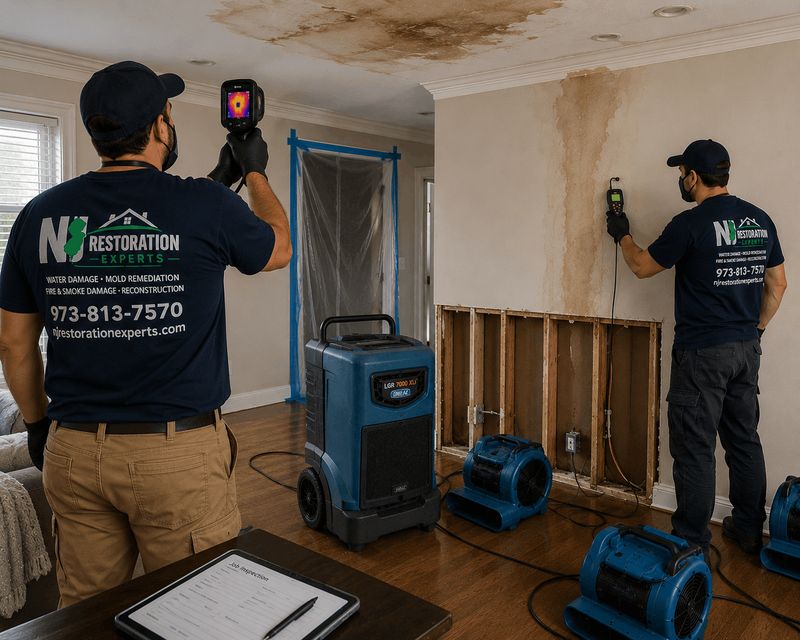
What Our Structural Drying & Dehumidification Service Includes
- Moisture Mapping & Drying Plan Design
- Low-Grain Refrigerant (LGR) Dehumidification
- High-Velocity Air Mover Placement
- Wall Cavity & Injection Drying Systems
- Hardwood Floor Drying Mat Systems
- Slab & Subfloor Drying
- Daily Moisture Readings & Drying Logs
- Dry-Standard Verification & Sign-Off
Why Fans Alone Don't Dry a Structure
Drying is an exchange: moisture leaves wet materials into the air, and the air's capacity to accept it depends on how dry that air is. Air movers accelerate evaporation at the surface — but without dehumidification, the released moisture simply raises the room's humidity until evaporation stalls, and worse, until moisture migrates into previously dry materials. A closed room full of rented fans reaches that equilibrium in hours; homeowners running it for a week are mostly redistributing water. Professional drying pairs airflow with commercial dehumidification that continuously strips moisture from the air, keeping the exchange running until the materials themselves give up their load.
Materials release water at wildly different rates, which is why one number never describes a drying job. Drywall dries in days; framing lumber that drank for hours holds moisture for a week or more; hardwood flooring bound to a wet subfloor needs specialty mat systems pulling moisture through the boards; and concrete slabs release water slowly for weeks, reading dry at the surface while the depth stays wet. Cavities — wall interiors, under cabinets, between floors — dry slowest of all without direct intervention, which is what injection drying systems exist for: forcing conditioned air into the spaces the room's airflow never reaches.
This is also why 'how long does drying take' has an honest answer of 2–5 days for typical losses and longer for slabs and hardwood — and why the real question is never the calendar but the readings. Industry dry standards define target moisture content by material, compared against unaffected reference readings from your own home. When every mapped point meets standard, the structure is dry. Until then, it's drying — no matter how it feels to the hand.
Water's Out but Is It Dry? How to Tell
If extraction already happened — by you or a previous contractor — here's how to judge whether structural drying is finished or faking it.
- Trust smell over touch: persistent damp or musty odor days after cleanup means bound moisture remains
- Check for new symptoms: cupping floorboards, bubbling paint, swelling trim — all post-cleanup moisture tells
- Ask any contractor for their drying logs — daily readings by location; no logs means no verification
- Don't close up walls or install flooring on feel — a $200 verification beats a $9,000 redo
- Keep air conditioning running; it's mild dehumidification and buys time without hurting anything
- Call 973-813-7570 for a moisture assessment — 30 minutes of readings answers the question for real
If a previous company pulled equipment after two days without showing you readings, be politely suspicious — equipment removal should follow the meters, not the schedule. We're happy to give a second-opinion moisture map on someone else's dry-out.
Our Structural Drying & Dehumidification Process
Map Everything Wet
Meters and thermal imaging establish moisture content at every affected point — walls, floors, cavities, framing — against dry references from unaffected areas of your home.
Engineer the Setup
Dehumidification capacity is calculated from the actual load and space; air movers and specialty systems are placed where the map says, not where looks suggest.
Attack the Cavities
Injection systems, floor mats, and targeted access dry the enclosed spaces — the places under-drying hides.
Verify Daily
Every day, every mapped point gets re-read and logged; equipment moves and scales as zones reach standard.
Hit Dry Standard
Drying ends when readings meet material-specific targets across the map — not when the schedule or the equipment rental runs out.
Document & Release
You receive the complete drying log — the proof your rebuild, your adjuster, and your future self need that this structure was dry when it closed up.
Insurance Claims for Structural Drying
Drying is a core covered cost in any covered water loss — carriers expect professional mitigation, and drying equipment, monitoring, and labor are standard claim components. What carriers increasingly scrutinize is duration and documentation: days of equipment are billed, so the drying log that justifies them is the difference between a smooth claim line and an audited one. Our daily readings answer that question before it's asked.
The logs also protect the other direction of your claim. If damage surfaces later — mold in a wall, failed flooring — documented dry-standard verification establishes that mitigation was completed properly, separating new problems from old ones. It's quiet paperwork with loud value, and every drying job we run produces it.
Why NJ Homeowners Call Us First
Meters Over Feelings
Every decision from setup to equipment pull follows instrument readings — surfaces lie, and we don't work by touch.
LGR-Grade Equipment
Low-grain refrigerant dehumidifiers keep extracting when household units and rental fans have stalled out.
Cavity Access Discipline
Wall interiors, under-cabinet voids, and floor systems get direct drying — the zones failed dry-outs skip.
Daily Logs, Shared
You see the same readings we do, every day — progress you can verify instead of promises you have to trust.
Second-Opinion Friendly
Someone else's dry-out looking suspicious? We'll map it honestly, including telling you it's fine if it is.
Rebuild-Safe Sign-Off
Nothing closes up until standard is met — the flooring, drywall, and paint that follow are built on verified dry.
Helpful Resources
For the concept in plain language, read what is structural drying and how long drying takes. Wondering whether your own dehumidifier can handle it? That comparison has its own post. Drying follows extraction — see water removal & extraction — and precedes rebuild at reconstruction. Worried it wasn't done right the first time? Start with signs of hidden water damage.
Structural Drying & Dehumidification — Frequently Asked Questions
Another company extracted the water and left fans for two days. Is that enough?
Sometimes — and the only honest answer comes from readings. Two days of air movement without commercial dehumidification and without documented moisture verification is the classic under-dry: surfaces feel fine while framing and cavities stay wet. We'll map it and tell you straight, including 'it's actually dry' when it is.
How long does structural drying really take?
Typical losses: 2–5 days of equipment runtime. Hardwood floors and concrete slabs: longer, sometimes considerably. The truthful version is that duration is an output of the readings, not an input — drying ends when materials hit standard, and we show you the daily numbers that decide it.
What's the difference between your dehumidifiers and mine?
Capacity and depth. Household units manage ambient comfort; LGR (low-grain refrigerant) dehumidifiers extract moisture from already-dry air, which is what pulling water out of materials requires in the late stages of drying. Your unit helps prevent problems; it can't finish a structural dry-out.
Can wet hardwood floors really be saved?
Often, when drying starts fast — specialty mat systems pull moisture through the boards while readings track progress, and cupping frequently subsides as moisture equalizes. Speed is the variable: hardwood that waits a week has usually decided already. It's one of the strongest arguments for professional drying over hopeful fans.
Do I need to leave my house during drying?
Almost never. The equipment is loud — think steady white noise — and rooms under drying are off-limits for comfort, but homes stay livable through the process. We place and route equipment to keep essential spaces usable, and the noise ends when the readings say so.
What happens if a structure gets closed up before it's dry?
The moisture finishes its work in private: mold colonizes the wall cavity, flooring installed over the damp slab fails, trim and paint telegraph the dampness within months. Then everything gets opened again, at rebuild prices. Dry-standard verification exists to make that story impossible.